Why Should I Use a Tutor?
Top 5 reasons Tutoring is a high-return investment in efficiency, self-awareness, and performance. It is a strategic tool used by high achievers to bypass classroom… Read More »Why Should I Use a Tutor?
Top 5 reasons Tutoring is a high-return investment in efficiency, self-awareness, and performance. It is a strategic tool used by high achievers to bypass classroom… Read More »Why Should I Use a Tutor?
Selecting a tutor is a high-stakes hiring decision. Beyond subject expertise, you are looking for consistency, pedagogical alignment, and professional transparency. Use these nine vetting criteria… Read More »Nine Questions to Ask a Prospective Tutor Before Committing
Sandra was attending the Convent of the Sacred Heart, and she told me that she had given up on math completely before finally deciding to… Read More »Giving up on math in middle school…
with many students for their placement tests, helping them realize their potential in high school and place into challenging and rewarding classes that match their… Read More »Placement Tests, Medical Leaves, Flexible Studies…
From an early age we are often informed – even if inadvertently – of our “limitations.” These supposed limitations might be imposed upon us by family, teachers, or friends: though often we impose them upon ourselves – by comparing ourselves to our peers or by telling ourselves we are not progressing quickly enough. If we are told – or tell ourselves – enough times that we are not smart enough or good enough at a subject or sport, we are likely to believe it. And once we believe it, Read More »Mythbusting: “I’m just not good at math!”
Many students really do struggle in math: I’m certainly not suggesting otherwise. Experiencing challenges is part of the learning process; but it’s also, frankly, part of the fun. By actively engaging with that process, you’re not just learning math; you’re also learning about yourself: about what keeps you attentive, about what models and methods “make sense” to you.
Find Your Style
Perhaps you discover that flash cards and rote memorization is your style; perhaps Read More »What if I find math hard?
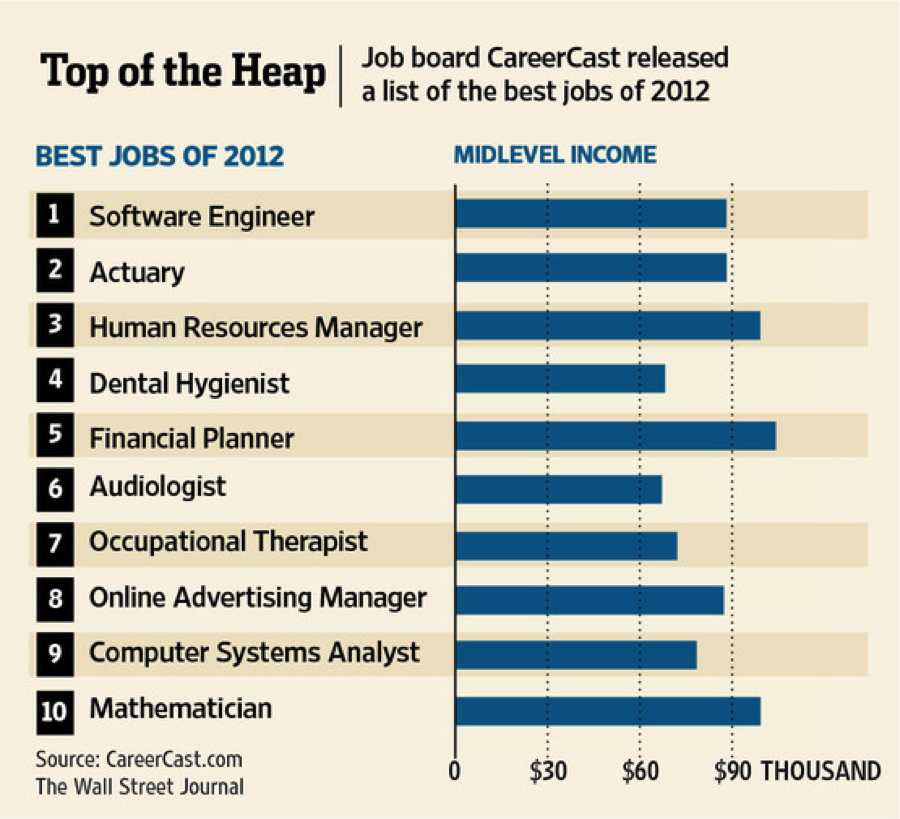 Studies by the career website CareerCast.com for the past several years have consistently shown that math is often the key to finding the best jobs. WSJ.com recently published an article “Dust Off Your Math Skills: Actuary is Best Job of 2013” reporting the results of the latest study.
CareerCast ranks 200 jobs from best to worst using the following criteria: physical demands, work environment, income, stress, and hiring outlook. Over the past few years, the top ranked jobs often involve some form of mathematics. Read More »Do The Math To Get The Best Jobs
Professional farmers don’t begrudge the backyard gardener his tomato harvest. That’s silly.
And talented mechanics certainly don’t mind the antics of the Car Talk guys (or their listeners). Sooner or later, if you need a real mechanic, you’ll find one, and if you don’t, well, that’s fine too.
Read More »True professionals don’t fear amateurs – Seth Godin
If you’re a middle school or high school student, or the parent of one, chances are high you’ve been hearing about this quasi-mysterious “AP” for quite awhile. But what do the AP program and the exams mean, what are they used for, where do they differ, and how can you participate in and prepare for the APs? My goal is to answer some of these basic questions in the following article.
Read More »What Should I Know About the AP Program and the AP Tests?
Continued from How Long Should I Study for the GMAT? – Part 1