Gaining admissions into some private middle and high schools is surprisingly similar to the college admissions process. Everything from a student’s grades, extra-curriculars, and teacher recommendations are looked at by the admissions officers at different schools. Since curricula, educational and assessment standards can vary widely from school to school, admissions personnel can compare students from varying backgrounds with respect to the “core subjects” using the standardized test scores.
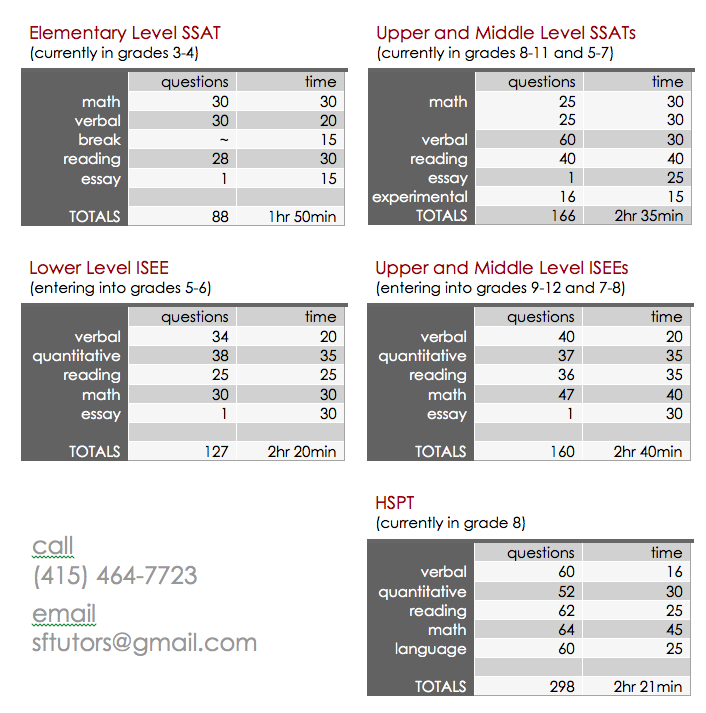
The most popular of these exams are The Secondary School Admission Test (SSAT), The Independent School Entrance Exam (ISEE), and The High School Placement Test (HSPT). The former two are prerequisites to be considered for admissions to many private or independent high schools, while the latter is taken for admissions to parochial (Catholic) high schools. Step one, as with any standardized test, is to determine which schools you’re interested in, and to find out each school’s requirements or preferences. Step two is to learn a bit about what to expect, and how you can begin to prepare. Here’s a breakdown of the three tests:
*Please note the times per section and for full tests are the regular, non-accommodated time.
SSAT
The SSAT is administered by the Secondary School Admission Test Board (SSATB), and is perhaps the most common of the three tests: nearly 800 schools worldwide make use of SSAT scores for admission decisions. Despite its obvious resemblances, the SSAT has no relation to the SAT. The SSAT is designed for students in grades 3 through PG and is administered on the Elementary, Middle, and Upper levels.
The Elementary Level is for students currently in grades 3 to 4 who are applying for admission to 4th or 5th grade. The Middle Level is for students currently in grades 5 to 7 applying for admission to 6th-8th and the Upper Level SSAT is for to students currently in grades 8-11 applying for admission to grades 9 through post graduate.
The Middle and Upper Level tests are comprised of five parts: a 25-minute essay and a four-part, 150-question multiple-choice test that spans Mathematics, Reading Comprehension, and Verbal Skills. While the essay is not scored by the SSATB, it is photocopied and forwarded to school admissions offices, and used by the school to evaluate a student’s writing abilities. The two Math sections are each 30 minutes long and contain 25 questions. These sections require basic computations including arithmetic, basic geometry, and basic algebra. The Verbal section is 30 minutes long and tests out-of-context vocabulary skills through 30 synonym and 30 analogy problems – there are no sentence completions on the SSAT. The Reading Comprehension section is 40 minutes long and contains 40 questions, all based around seven discrete reading passages. The full test takes 155 minutes.
Middle level students are presented with a choice of two creative prompts, whereas upper level students are presented with a choice of two prompts (one creative, one essay). In each case, the student will choose one.
The Elementary Level SSAT is a multiple-choice admission test that consists of four sections; Math – 30 questions, 30 minutes, Verbal – 30 questions, 20 minutes, Reading – 28 questions, 30 minutes and the Writing Sample – 1 prompt, 15 minutes. The full test takes 110 minutes.
Administrations of the SSAT in 2016-17 will also include an experimental section of 16 questions, lasting 15 minutes. This section is used to test the questions that may appear on future versions of the SSAT and is not scored.
Each question on the SSAT is equal in value and scores are determined by taking the sum of the correct answers (1 point each) and subtracting the questions you’ve answered incorrectly (one-quarter point each deduction). This is one of the major points of difference between the SSAT and the ISEE, which deducts no points for an incorrect answer. The SSAT is administered generally eight times a year. You can register at www.ssat.org.
Everything that the SSAT covers is based on skills you’ve been learning in school, so if you’ve been keeping up on your studies to date, you’ve got a good head start. Still, it is always good to be prepared well in advance of the test. And while you’re allowed to test as many of the eight dates as you’d like, it’s best not to take the exam more than twice. One of the most effective ways to do this is by taking at home practice tests, and using specific SSAT practice materials. More information on test preparation and what to expect can be found at http://www.ssat.org/test-prep/official-guide and http://www.ssat.org/test-prep/test-taking-strategies
2016-2017 SSAT Test Dates are;
Saturday, October 15, 2016
Saturday, November 12, 2016
Saturday, December 10, 2016
Saturday, January 7, 2017
Saturday, February 11, 2017
Saturday, March 4, 2017
Saturday, April 22,2017
Saturday, June 27, 2017
ISEE-Independent School Entrance Exam
The ISEE is designed and administered by the Educational Records Bureau (ERB), with input from faculty and administrators at independent schools. It is a test to determine admission into grades 2-12 and the scores are given as percentages rather than on a raw scale. There are four levels of the ISEE: the Primary Level is for students entering grades 2-4 (only available online) the Lower Level is for students entering grades 5 and 6, the Middle Level is for students entering grades 7 and 8, and the Upper Level is for students entering grades 9 through 12. The Lower, Middle and Upper Levels are all offered both online as well as pencil/paper administration. Students sitting for the Middle-Level and Upper-Level tests actually receive the same exam, but the scores are scaled differently –scores from the three levels cannot be compared.
The ISEE is composed of four multiple-choice sections and a 30-minute essay; 1 Verbal Reasoning section that contains Synonyms and Sentence Completion questions; 1 Quantitative Reasoning section with questions that require a knowledge of Arithmetic, Geometry, Algebra, and higher order thinking; 1 Reading Comprehension section that will test a student’s reading comprehension and 1 Mathematics Achievement section which tests the same skills the Quantitative Reasoning section tests. The difference between the two Math sections is that the former contains problem-solving questions and the latter contains quantitative comparison questions, which require the ability to compare two columns of numbers. (NOTE: this is a particularly important section to be prepared for, as students who see it for the first time are often confused). There are about 160 questions in total and the exam is about 2 hours 40 minutes long. The essay is not scored, but rather forwarded to the applicant’s school. One important thing to know is that the ISEE does not deduct points for wrong answers: this means you should always guess on every question; there’s no benefit to leave an answer blank!
The ISSE is administered once a month between November and April, and then administered again in June. Applicants generally take the ISEE in the fall or winter of the year before they apply to schools. The ISEE can be taken up to three times by a student within a twelve month admission cycle, once in any or all of three testing seasons (Fall, Winter, Spring/Summer). For the first time students and families will not be required to select a school score recipient when registering for the ISEE. Scores can be reviewed by students and families before being sent to any chosen schools. It is important to note that if a student decides to take the test more than once in a 12 month admission cycle, the score reports will not reflect how many times the test was taken by that particular student. It can also only be taken when you plan on formally applying to an educational institution: there’s no such thing as a “practice test” when it comes to the ISEE. Once you’ve registered, you’ll be sent information by the ERB on the time and location of your test. To register, you can visit http://erblearn.org/parents/admission/isee
While many prep books are available for this test (often coupled with prep work for the SSAT), your best source is the administrator. The ERB sells a copy of “What to Expect on the ISEE” on its website; this booklet contains a good number of questions used on past exams.
HSPT-Scholastic Testing Service High School Placement Test
The HSPT is only administered to 8th-grade students to determine admissions and placement in freshman-year classes of Catholic schools. The test was formulated and is administered by the Scholastic Testing Service (STS), and thus is sometimes referred to as the “STS-HSPT.” The exam time is approximately 2.5 hours; not including the optional additional sections (Science, Mechanical Aptitude, and Religious (Catholic) Knowledge). The test in its most basic form contains five sections and, without any additional sections listed above, is consistent with state requirements in terms of the “core knowledge:” reading, language skill, arithmetic, algebra, and geometry. Unlike many other standardized tests there is no essay section on the HSPT; all of the questions are in a multiple-choice format that consists of 5 sections: Verbal Skills (logic, analogies, synonyms, antonyms); Quantitative Skills (series, number manipulations, geometry, non-geometric comparisons); Reading Comprehension; Math (arithmetic, geometry, algebra); and Language Skills (punctuation, spelling, usage, grammar, and composition). Scores are reported on a scale of 200-800 – and like the ISEE, wrong answers do not detract from the score, so it is best to make a (preferably educated) guess on every question! The question-to-time ratio breaks are as followed: Verbal Skills (60 questions, 16 minutes); Quantitative Skills (52 questions, 30 minutes); Reading (62 questions, 25 minutes); Mathematics (64 questions, 45 minutes); Language Skills (60 questions, 25 minutes). There are 298 questions in total. A student’s raw score will be tallied and converted to a scaled score ranging from 200 to 800.The score report will designate both local and national percentile rankings, and will also be indicated as a grade equivalent. Percentile rankings show where a student falls in relation to other students, helping schools look at and compare candidates more easily.
The exam is held on location at the school that requires it and can be offered a number of times throughout the year, depending upon the specific schools being applied to. Individual schools handle all details of test administration and they determine which days they will offer the HSPT. Contact specific schools directly to find out their testing dates. Each school will provide students with registration forms, a handbook and an entrance ticket. Common test dates occur during the spring and fall. Unfortunately, there is no “official” practice material for the HSPT through the STS, although many test prep companies have written practice books with sample tests and strategies. http://www.ststesting.com/hsptpg9.html
FINAL THOUGHTS
Regardless of age, grade, and interests, it can be difficult for students and families to know where to start when thinking about the school admissions process. It is always a good idea to begin identifying the schools you’re interested in at least a year before the application process begins. Admissions offices will supply you with all the information you need in regards to deadlines and testing requirements. No matter which test you’re planning to take, definitely give yourself a diagnostic test first to become more familiar with the format, timing and any areas that need to be improved or reinforced. Most students who sit for these tests are newcomers to the standardized-test taking experience, and it’s best to know where you stand in the beginning, and where you need most to focus your energies while studying
Bear in mind that, as with college exams, admissions offices of independent and parochial schools will be looking at much more than your high school entrance exam – so don’t put all your eggs in one educational basket. Just as admissions officers are looking for well rounded students for their schools it is important that your study and preparation techniques, regardless of the test or tests you choose to take, encompass and balance all different aspects of how to be successful when testing. With a bit of planning, a lot of practice, and a lot of attention to your nerves and your health in the weeks before the exam, you’ll be well prepared.
Download a PDF version of this article
Ender Markal
Founder, Math Tutor – SFTutors